
How PCIe Gen6 Is Reshaping Enterprise Storage: From Gen5 SSDs to Next-Generation AI Storage
How PCIe topology, latency and cooling shape the role of next-generation NVMe SSDs in AI data delivery.
When a GPU waits for data, locate the queue
A training batch passes through reads, decompression, sampling and transfers before the GPU can use it. A faster SSD may not help if decompression dominates. Replacing individual drives may also leave aggregate throughput unchanged when a shared uplink is full. Storage feeding is a property of the complete data path.
Place each generation in its workload context
Gen5 platforms such as Micron 9550 and Samsung PM1743 already make host I/O configuration a central selection issue. Moving to a Gen6 Micron 9650 or Samsung PM1763 still requires a compatible path. An unchanged shared uplink can prevent the faster drive interface from being fully used.
Interface generation is not a workload category, either. Micron 7600’s emphasis on responsiveness addresses a different requirement from the capacity-led positioning of Micron 6600 ION and Samsung BM1743. Low-queue-depth request latency and sustained large-file reads cannot be judged by one maximum throughput figure.
Form factor and cooling are part of the design
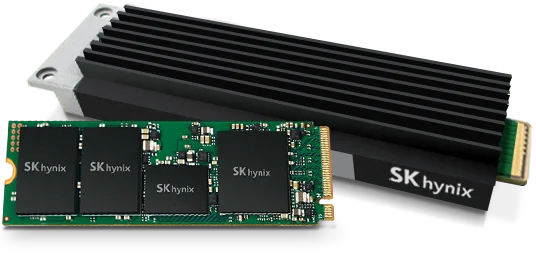
E1.S, E3.S and U.2 / U.3 describe more than appearance: bay support, connections and chassis compatibility matter. SK hynix’s DTF presentation includes PEB210, PS1110 and PS1101 and illustrates liquid-cooling and capacity directions. A demonstration is not evidence that every configuration is deployment-ready. Check bay support, thermal design and firmware rather than treating NVMe as a guarantee of interchangeability.
Read capacity and endurance separately
30.72TB, 61.44TB, 128TB+ and the 245TB class illustrate the expansion of dense storage, not options guaranteed across every family. Micron, for example, lists 245.76TB usable capacity for a 6600 ION configuration. Raw NAND and usable capacity must not be confused. TLC, QLC and DWPD answer different questions; evaluate actual writes over the warranty period, including write amplification and workload behavior.
Checkpoint traffic can change a read benchmark’s answer
A dataset-read test can miss the write bursts that arrive during training. When checkpoints share storage with other work, average throughput may still look healthy while slower requests extend job completion. Cold starts and cache hits also answer different questions.
The value of Gen6 is not the sum of each drive’s best figure. It is whether a genuinely constrained data path can reduce GPU idle time. Queue depth, block size, steady-state writes and temperature are necessary context for that result.
Related research
Sources / References
- Micron data-center SSD portfolio
- Micron 6600 ION
- Samsung PM1763
- Samsung enterprise SSD portfolio
- SK hynix DTF 2026
Research reviewed on 2026-09-07. Product references are for technical analysis, not a supply commitment. Deployment depends on the exact system and software configuration.