
Enterprise Server CPU Trends 2026: Intel Xeon 6+ and AMD EPYC 9006
Beyond core counts: evaluate server CPUs through memory bandwidth per core, platform configuration and I/O topology.
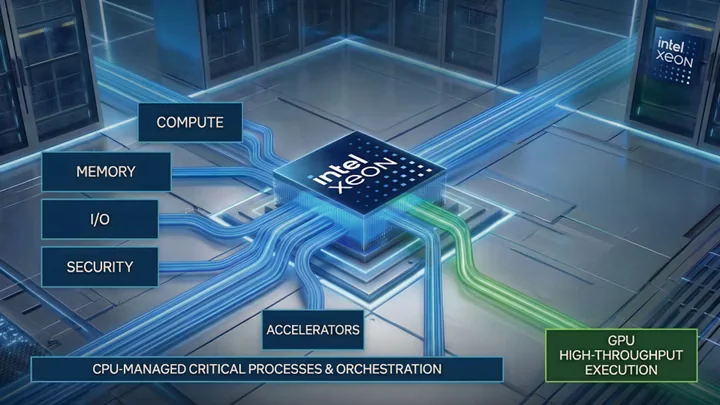
Why the host CPU still matters in a GPU server
A GPU executes the model; it does not arrange its own input pipeline. Decoding, data preparation, scheduling and storage coordination may still run on the host CPU. When those stages fall behind, expensive accelerators wait. Moving from the main compute engine to a component of the data path makes the CPU different, not irrelevant.
Nor is a high core count a guarantee. Once memory channels or an I/O path are saturated, extra threads add contention. Comparing Xeon and EPYC therefore requires a view of core design, bandwidth available per core and device attachment—not just the total number of cores.
Xeon 6 to Xeon 6+: identify the core design
Xeon 6 spans different core approaches rather than a single performance curve. Clearwater Forest is the E-core direction of Xeon 6+; Intel ARK lists Xeon 6990E+, Xeon 6980E+, Xeon 6970E+ and Xeon 6960E+ as distinct configurations. Density-led deployments should examine resources per core, sustained utilization and power constraints. Workloads that depend on strong individual threads need a measured comparison with the relevant P-core platform, not a core-count contest.
Turin to Venice: include the platform transition
AMD EPYC 9005 Turin and EPYC 9006 Venice represent different platform generations. AMD describes Venice through Zen 6 / Zen 6c, DDR5, MRDIMM and PCIe Gen6 capabilities. Cross-check them against the selected CPU, motherboard and memory support documentation. A newer interface expands the I/O envelope, but an older device does not acquire a newer link speed simply by moving to that platform. Firmware and OEM qualification remain part of deployment.
The CPU still owns important parts of the AI pipeline
Even when GPUs execute the main model, CPUs may handle decoding, preparation, scheduling and storage coordination. Slow preprocessing can leave accelerators idle. Multi-socket systems add NUMA considerations: the placement of a NIC, NVMe drive or GPU under a root complex can change cross-socket traffic. Aligning threads and memory allocation with that topology is often worth testing before adding more cores.
A speed label cannot compensate for poor population
Equal memory capacity does not imply equal data delivery. Concentrating modules on fewer channels can behave differently from distributing them across available channels. Operating speed also depends on module type, DIMMs per channel and platform support. MRDIMM requires a compatible platform rather than merely a matching capacity target.
A CPU upgrade evaluation therefore needs more than the processor part number: channel population, negotiated memory speed, NUMA placement and PCIe topology belong in the record. Without them, two superficially similar system results may not be comparable.
Related research
Sources / References
- Intel Clearwater Forest product family
- Intel Xeon 6+ overview
- AMD EPYC 9006
- AMD EPYC 9005 and 9006 context
Research reviewed on 2026-09-07. Product references are for technical analysis, not a supply commitment. Deployment depends on the exact system and software configuration.