
Enterprise AI GPU Trends 2026: From Hopper and Blackwell to Vera Rubin
How memory, numerical precision and rack-scale interconnects are changing the evaluation of NVIDIA and AMD AI platforms.
Why more GPUs may not produce a faster service
Consider an inference service that can already load its model into GPU memory. As concurrency rises, response times deteriorate. Compute is not necessarily the constraint: requests enlarge the KV cache while memory accesses and inter-GPU transfers compete for resources. A training job might instead pause for checkpoint writes. Both leave GPUs waiting, but buying more compute addresses neither cause directly.
That distinction explains the growing emphasis on HBM, interconnects and rack design. A peak figure describes the ceiling for a particular operation. The useful system metric is completed work at an agreed quality level, latency and power envelope.
Hopper to Blackwell: memory and precision move together
H100 and H200 both belong to Hopper, but their differences are not simply a matter of compute speed. NVIDIA lists 141GB of HBM3e for H200. More local memory can change whether a model fits on an accelerator and how much partitioning it needs. With B200 and B300 / Blackwell Ultra, evaluation also extends to lower-precision execution. FP8 and FP4 peak figures are not interchangeable, nor does lower precision preserve quality automatically. Quantization calibration, kernel support and output quality need to be tested together.
GB200, GB300 and Vera Rubin change the unit of comparison
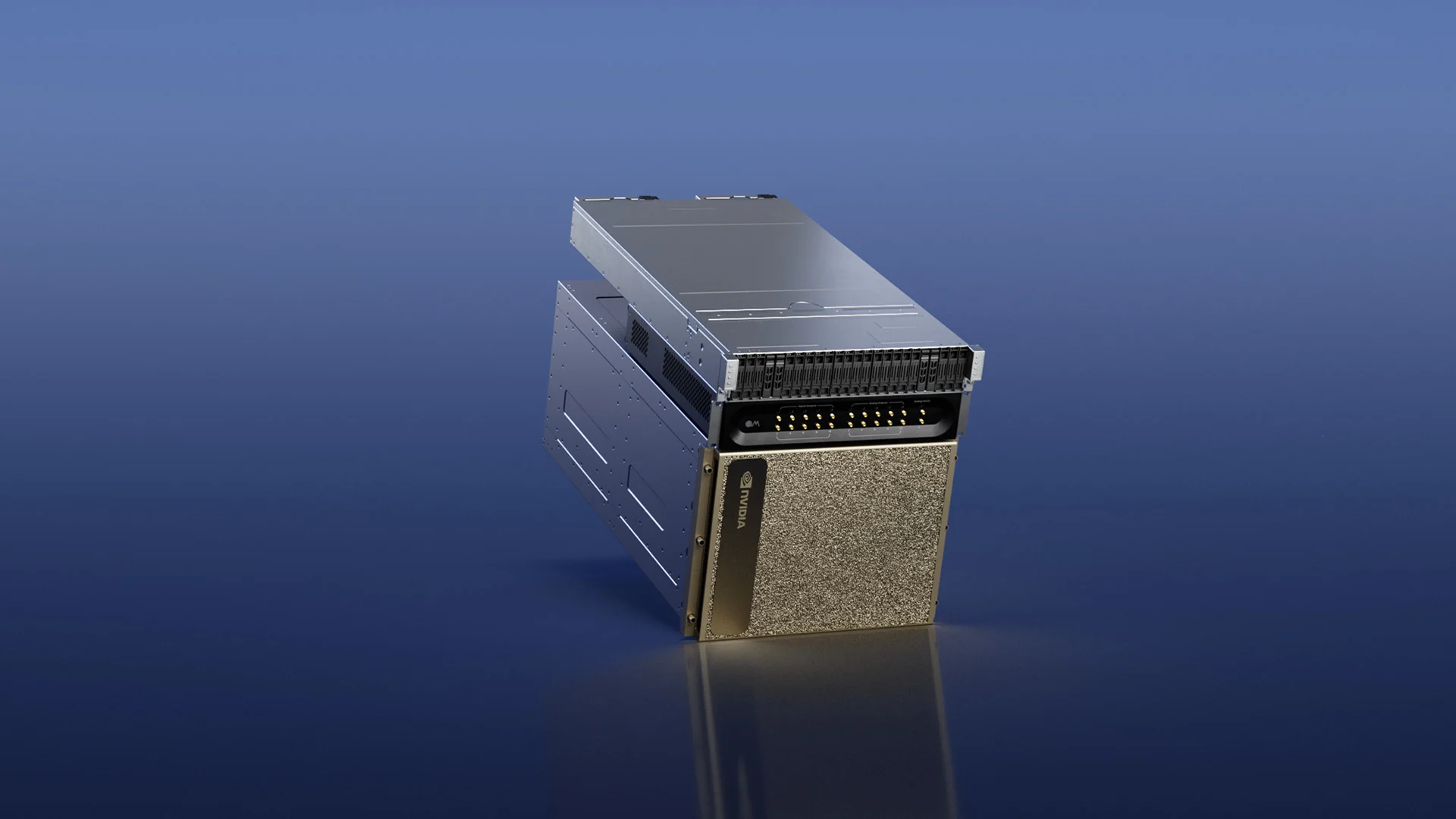
GB200 NVL72, GB300 NVL72 and Vera Rubin NVL72 move attention from the individual card to coordinated operation within a rack. NVIDIA presents Vera Rubin as a co-designed CPU, GPU and interconnect platform, with HBM4 part of the memory transition. The practical question is how many communication boundaries a job crosses, not just how many GPUs it receives. A larger high-speed domain still needs suitable scheduling, networking and data delivery; it does not eliminate every source of waiting.
AMD: evaluate the software and system alongside memory
The move from MI300X to MI325X illustrates the transition from HBM3 to HBM3E. MI350X and MI355X extend the discussion to CDNA 4 and low-precision execution, while MI455X and AMD Helios bring rack-scale systems into view. Cross-vendor comparisons should not stop at a theoretical headline. Model portability, framework versions, kernel coverage, collective communication and recovery behavior all affect useful utilization. Tests need the same dataset, quality threshold and service-latency target, with software versions recorded.
Different form factors solve different problems
RTX PRO 6000 Blackwell Server Edition and RTX PRO 6000 Blackwell Workstation Edition belong in the discussion, but should not be compared with NVL72 systems on price or peak compute alone. Workstation visualization, enterprise inference and large training jobs have different cooling, display and management requirements. Establish the workload first, then validate chassis, power, cooling and software support. A liquid-cooling assessment must also address facility connections, maintenance and leak response—not merely an accelerator power rating.
Power density brings the facility into the purchase
When more accelerators operate within one communication domain, power delivery and heat removal become selection criteria rather than installation details. Usable rack capacity depends on sustained cooling and on how much service remains available during maintenance.
NVIDIA labels Vera Rubin specifications as preliminary and subject to change. The architecture can inform planning without being treated as a qualified deployment or delivery commitment. For an existing system, locating GPU waits in memory, networking or data delivery is the most useful evidence for deciding where the next investment belongs.
Related research
Sources / References
- NVIDIA H200
- NVIDIA GB300 NVL72
- NVIDIA Vera Rubin NVL72
- AMD Instinct MI300 Series
- AMD Instinct MI355X
- AMD Instinct portfolio
- NVIDIA RTX PRO announcement
Research reviewed on 2026-09-07. Product references are for technical analysis, not a supply commitment. Deployment depends on the exact system and software configuration.