
AI Server Memory Trends: DDR5 RDIMM, MRDIMM, SOCAMM2 and High-Capacity Modules
Distinguishing capacity, bandwidth and latency across RDIMM, MRDIMM, SOCAMM2 and HBM in AI systems.
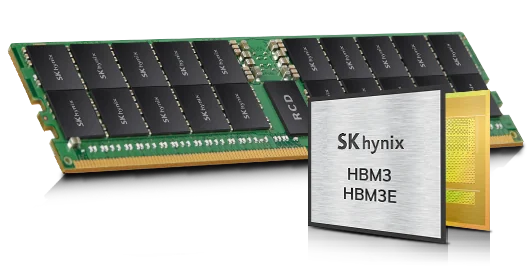
More HBM does not remove host-memory pressure
A model may reside in GPU memory while datasets, preprocessing buffers and host processes still occupy system memory. As more GPUs share a loading pipeline, DDR5 must both hold the working set and feed it fast enough. Those are separate constraints: insufficient capacity can cause paging, while a workload that fits can still be bandwidth-limited.
64GB, 96GB, 128GB and 256GB modules are configuration choices, not a performance ranking. How the total capacity is distributed across channels often deserves attention before the capacity of an individual module.
RDIMM and 3DS: balance density with channel population
DDR5 RDIMM is an important server memory format, while 3DS RDIMM involves stacked-DRAM capacity design. Options from SK hynix, Micron and Samsung require complete part numbers and OEM qualification checks. DDR5-6400, DDR5-8000 and DDR5-8800 cannot be discussed independently of module type. In particular, an 8800 MT/s MRDIMM specification is not a promise that an arbitrary DDR5 RDIMM can run at that rate.
MRDIMM increases the delivery envelope
Micron connects MRDIMM to the bandwidth needs of high-core-count CPUs. Multiplexed buffering expands data-transfer capability, but does not imply that every kind of latency falls proportionally. Test the actual read/write mix, working set and concurrency. Faster transfers cannot resolve paging caused by insufficient capacity. Development targets such as 12,800 MT/s must remain distinct from a qualified module on a specific system.
SOCAMM2 and HBM are different tiers
SOCAMM2 brings a low-power memory approach into the data center; Micron’s implementation is based on LPDDR5X. It is not a drop-in replacement for a conventional RDIMM. HBM3E and HBM4 belong to the high-bandwidth memory path near accelerators rather than user-replaceable DIMMs. Adding host-memory and GPU-memory capacities together does not make their access costs equal. Data placement remains an architectural decision.
Record capacity headroom, sustained bandwidth, tail latency and power together. Hold CPU, firmware and power settings steady while changing memory configuration; otherwise several changes can be mistaken for a module-level benefit. In AI workloads, observe time spent waiting for data at the GPU. Faster host memory may deliver little improvement when storage or networking is the actual constraint.
Related research
Sources / References
Research reviewed on 2026-09-07. Product references are for technical analysis, not a supply commitment. Deployment depends on the exact system and software configuration.